
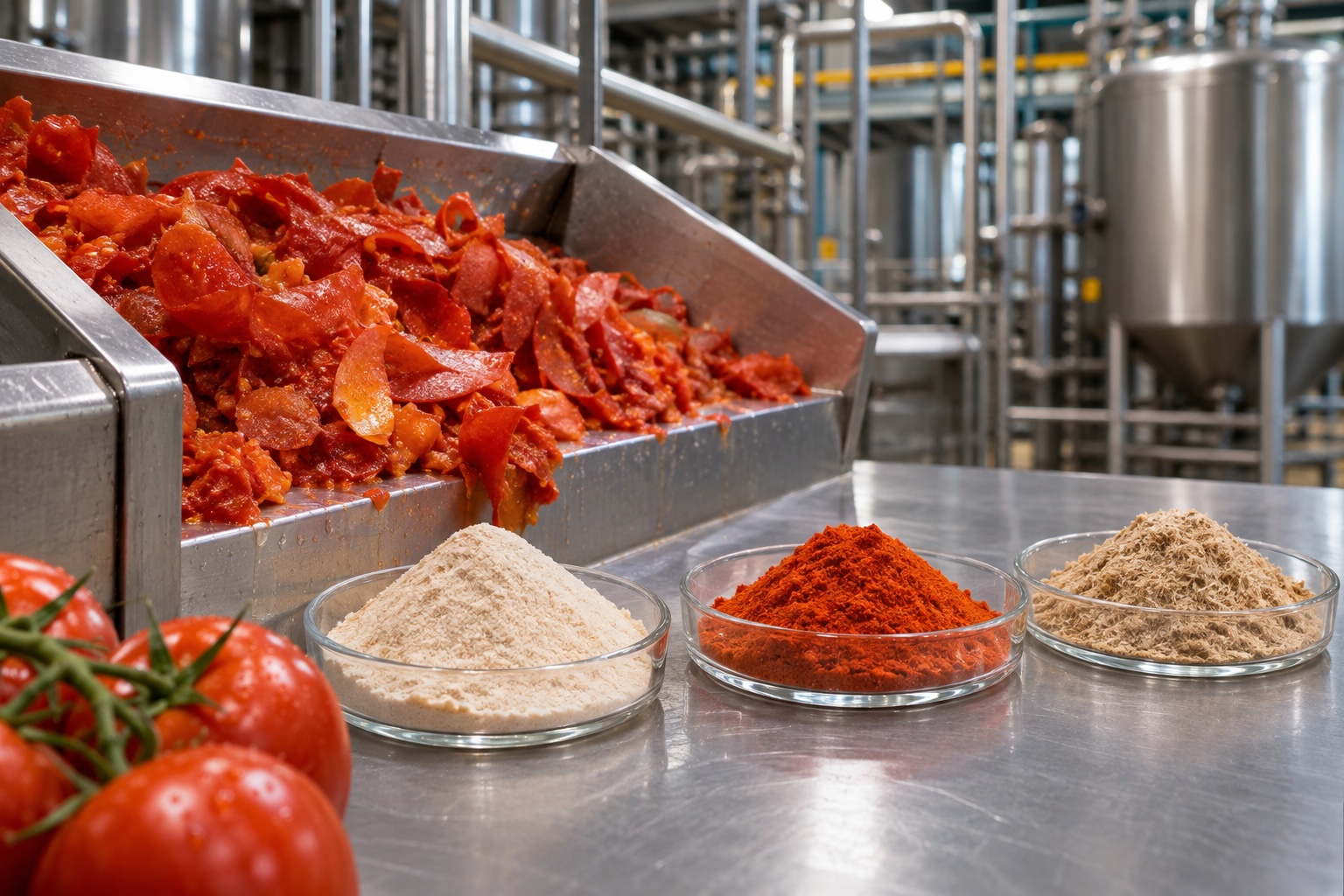
Tomato processing generates substantial quantities of secondary materials that are often directed towards animal feed, composting or other low-value applications. However, tomato peels, seeds and residual pulp contain compounds with potential applications in the food, nutraceutical and ingredient industries. Their valorisation represents an opportunity for processors to improve resource efficiency while exploring additional revenue streams from existing industrial operations.
The commercial potential of tomato by-products extends beyond lycopene, traditionally one of the most recognised compounds associated with tomato processing residues. Pectin, carotenoids and dietary fibre offer different opportunities for ingredient development, each characterised by specific technical requirements, market applications and industrial challenges.
Understanding the Composition of Tomato By-Products
Industrial tomato processing produces different residual fractions depending on the technology employed and the final product being manufactured. Peels are particularly relevant for their carotenoid content and structural polysaccharides, while seeds contain proteins, lipids and other potentially recoverable components. Residual pulp and mixed processing streams may provide additional sources of dietary fibre and pectic substances. The composition of these materials varies according to tomato variety, cultivation conditions, ripeness and processing parameters. Thermal treatments, mechanical separation and storage conditions can significantly influence the characteristics of the resulting by-products and the recovery potential of their valuable components. For industrial valorisation, understanding these variables is essential. A technically promising extraction process must be supported by consistent raw material availability, predictable composition and a recovery strategy compatible with the existing production environment.
Pectin: Exploring Functional Ingredient Opportunities
Pectin is a complex polysaccharide naturally present in plant cell walls and widely used in the food industry for its gelling, thickening and stabilising properties. Commercial pectin production is currently dominated by citrus peels and apple pomace, which benefit from established supply chains and mature extraction technologies. Tomato processing residues contain pectic substances that may provide an alternative source of functional ingredients. Their recovery could create opportunities for processors seeking to diversify the value generated from their secondary materials. However, tomato-derived pectin cannot automatically be considered equivalent to established commercial pectins. Its molecular structure, degree of esterification, molecular weight distribution and functional behaviour must be evaluated against the requirements of specific applications. Potential uses may include food formulations, texture modification and specialised ingredient systems, provided that the recovered material demonstrates suitable performance and consistency. From an industrial perspective, the challenge is not simply extracting pectin, but developing a product with functional characteristics that justify its production costs and offer a credible alternative within an already competitive market.
Carotenoids: Beyond Lycopene
Tomatoes are recognised sources of carotenoids, particularly lycopene, the pigment responsible for much of their characteristic red colour. Tomato processing residues, especially peels, can retain significant quantities of these compounds, making them interesting candidates for recovery and further processing. Lycopene has established applications in food colouring, dietary supplements and specialised formulations. Nevertheless, the commercial market includes experienced producers with established extraction capabilities, standardised ingredients and consolidated customer relationships. For new industrial projects, this competitive environment makes differentiation particularly important. Beyond lycopene, tomato-derived carotenoid fractions may contain beta-carotene and other minor carotenoids, depending on the raw material and extraction process. Their potential applications include natural colour formulations, nutritional ingredients and specialised blends. Rather than focusing exclusively on the recovery of a single purified compound, industrial development may also investigate carotenoid-rich extracts with defined compositions and functional characteristics. The appropriate strategy depends on the intended application, regulatory requirements, stability, bioavailability considerations and the specifications established by prospective buyers. Extraction efficiency alone is therefore insufficient to determine commercial feasibility. The final ingredient must demonstrate reproducible quality, appropriate stability and a competitive cost structure.
Dietary Fibre: A Broader Ingredient Perspective
Dietary fibre represents another potentially valuable fraction of tomato processing by-products. Tomato peels and residual pulp contain insoluble and soluble fibre components that may be recovered and incorporated into food ingredient systems. The growing interest in fibre enrichment, plant-based formulations and the functional properties of natural ingredients creates opportunities for exploring alternative fibre sources. Tomato-derived fibre may be investigated for applications in bakery products, snacks, prepared foods and other formulations where water retention, texture or nutritional composition are relevant. However, its industrial value depends on more than total fibre content. Particle size, water-holding capacity, oil-binding properties, colour, flavour and microbiological quality all influence the suitability of a fibre ingredient for a particular application. Tomato-derived materials may also introduce sensory characteristics that limit their use in certain formulations. Consequently, the development of a commercially viable fibre ingredient requires careful consideration of processing methods, product specifications and the needs of the target food manufacturer. In some cases, relatively simple stabilisation, drying and milling operations may offer a more accessible industrial route than complex extraction and purification processes. This possibility should be assessed through a comparative evaluation of investment requirements, operating costs and achievable market value.
Integrating Recovery Technologies into Industrial Operations
The recovery of pectin, carotenoids and dietary fibre should not necessarily be approached as three independent industrial activities. Their development can be considered within an integrated valorisation strategy designed to maximise the utilisation of tomato processing residues. Different separation and extraction technologies may be evaluated according to the characteristics of the feedstock and the intended products. These include conventional extraction processes, mechanical separation, membrane technologies and ultrasound-assisted extraction. Ultrasound-assisted processes are particularly interesting as a potential means of improving mass transfer and supporting the recovery of selected compounds under appropriately designed operating conditions. Their effectiveness, however, depends on the material being processed, the target compound and the specific process parameters. An integrated approach may involve the sequential recovery of selected compounds, followed by the utilisation of remaining fractions for other applications. Such configurations require careful technical assessment. The extraction of one component may alter the properties or commercial suitability of subsequent fractions, while additional processing stages can increase energy consumption, water requirements and operational complexity. The objective should therefore be to identify a technically coherent and economically sustainable combination of processes rather than pursuing the maximum theoretical recovery of every available compound.
From Laboratory Results to Industrial Feasibility
One of the principal challenges in by-product valorisation is translating promising laboratory results into reliable industrial operations. A successful extraction experiment demonstrates technical potential, but does not establish the economic viability of a production facility. Industrial feasibility depends on several interconnected factors, including annual feedstock volumes, seasonal availability, material stability, extraction yields, processing costs, energy consumption, product quality and the investment required to achieve commercial production. Tomato processing is particularly sensitive to seasonality. Large quantities of secondary materials may become available during relatively concentrated production periods, creating logistical challenges for storage, stabilisation and continuous operation. The geographical location of a processing facility also influences the feasibility of different recovery strategies. Access to utilities, technical expertise, transport infrastructure and potential customers can substantially affect the overall economics of a project. For this reason, the evaluation of tomato by-product valorisation should begin with a detailed understanding of the existing industrial operation and its available resources.
Commercial Requirements Must Guide Product Development
The existence of valuable compounds within tomato processing residues does not automatically translate into market demand for the resulting ingredients. A commercially oriented development programme should identify potential customers and applications before committing to a specific extraction or processing technology. For pectin, this means understanding the functional specifications required by food manufacturers and determining whether tomato-derived material can deliver a competitive performance. For carotenoids, the assessment must consider composition, purity, stability, regulatory compliance and the expectations of ingredient manufacturers or formulators. For dietary fibre, the evaluation should address nutritional characteristics, technological functionality, sensory performance and the requirements of the intended food applications. In each case, the commercial opportunity is defined by the relationship between product performance, manufacturing cost and customer requirements. This approach helps avoid a common limitation of by-product valorisation projects: developing a technically successful extract without establishing a sufficiently clear route to market.
Building Industrial Value Through Strategic Partnerships
For tomato processors, the transition from secondary material management to ingredient production may require capabilities that extend beyond their traditional business activities. Extraction technologies, ingredient formulation, quality assurance, regulatory assessment and commercial development represent different areas of expertise that must be coordinated throughout the project. Strategic partnerships and joint ventures can provide a framework for combining industrial resources with specialised technical and commercial knowledge. A tomato processor may contribute feedstock availability, production infrastructure and operational experience, while technology partners support process development and ingredient specialists contribute formulation expertise, product qualification and access to potential markets. The structure of such partnerships should reflect the technical maturity of the proposed products, the investment requirements and the commercial opportunities identified during preliminary feasibility studies. At Letoon, we consider this integration of industrial resources, applied research and commercial requirements essential to developing credible by-product valorisation projects.
Tomato processing residues represent an interesting starting point for the development of pectin, carotenoid and dietary fibre ingredients. Their potential value, however, must be demonstrated through a combination of technical validation, industrial feasibility and market-oriented product development. The opportunity is not simply to extract more compounds from tomato by-products, but to transform existing processing resources into commercially relevant ingredients through sustainable and economically viable industrial models.