
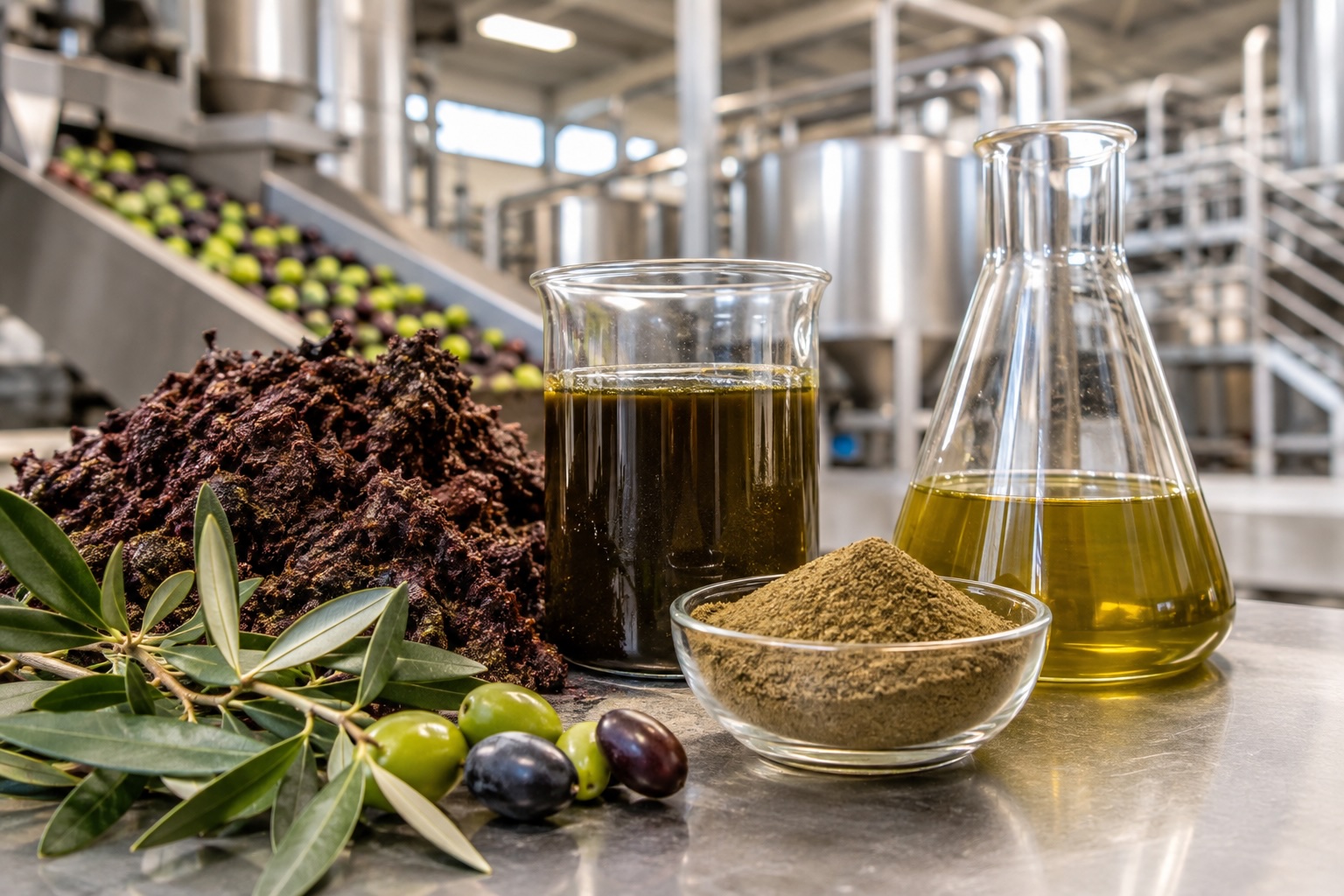
The olive oil industry generates substantial volumes of secondary materials throughout the production process. Olive pomace, olive mill wastewater, leaves and other processing residues contain a variety of compounds with potential commercial value. Among these, polyphenols have attracted considerable attention for their antioxidant properties and potential applications in food ingredients, nutraceuticals, cosmetics and other industrial sectors. For olive processors, these materials represent an opportunity to explore new business models beyond traditional oil production. However, transforming olive processing by-products into commercially viable ingredients requires more than identifying valuable compounds. It involves understanding raw material characteristics, selecting appropriate extraction technologies, defining product specifications and establishing a clear relationship between industrial feasibility and market demand.
Understanding the Value of Olive Processing By-Products
Olive processing generates different categories of secondary materials depending on the production technology, olive variety, harvesting conditions and processing methods. Two-phase and three-phase extraction systems produce different distributions of solid and liquid residues, influencing their composition, moisture content and potential recovery pathways. Olive pomace contains residual oil, water, pulp, skin and fragments of olive stones. Depending on processing conditions, it may also retain phenolic compounds, dietary fibre and other constituents of industrial interest. Olive mill wastewater, particularly associated with three-phase extraction systems, can contain significant concentrations of water-soluble phenolic compounds, although its composition and environmental characteristics require careful management. Olive leaves, collected during harvesting and preliminary processing, represent another potential source of bioactive compounds. Their composition differs from that of pomace and wastewater, making them relevant to distinct extraction strategies and commercial applications. These differences are fundamental when evaluating industrial opportunities, as each material stream requires specific characterisation, handling procedures and technological solutions.
Polyphenols: From Natural Compounds to Industrial Ingredients
Polyphenols are among the most extensively studied constituents of olives and olive-derived materials. Hydroxytyrosol, tyrosol, oleuropein and related phenolic compounds are particularly relevant to the development of specialised ingredients. Their distribution varies considerably across different raw materials: oleuropein is especially associated with olive leaves, while hydroxytyrosol and related compounds may be present in olive processing residues, including aqueous fractions. From an industrial perspective, the commercial potential of these compounds depends on their concentration, purity, stability and suitability for specific applications. An extract containing a high total polyphenol concentration is not necessarily equivalent to an ingredient standardised for a particular molecule or phenolic profile. This distinction becomes important when addressing manufacturers of food supplements, functional ingredients and cosmetic formulations, where buyers may require defined concentrations, consistent analytical profiles, microbiological compliance, controlled contaminants and evidence supporting the intended application. Consequently, the development of an olive-derived polyphenol ingredient must begin with a clear understanding of the target market and its technical requirements.
Industrial Applications in Food, Nutraceuticals and Cosmetics
Olive-derived polyphenols offer several potential routes to industrial application, although each market presents different technological, regulatory and commercial requirements. In the food industry, phenolic extracts may be investigated as antioxidant ingredients, particularly where manufacturers seek alternatives to conventional formulations or wish to develop products incorporating compounds of natural origin. Their effectiveness depends on the food matrix, processing conditions, sensory impact and stability during storage. The nutraceutical sector represents another area of interest, with hydroxytyrosol and other olive phenolics studied for their biological activities and potential use in standardised ingredients. Nevertheless, commercial applications must comply with the applicable regulatory framework, including requirements concerning ingredient authorisation, safety and permitted health claims. In the European Union, certain health claims relating to olive oil polyphenols are authorised under specific conditions, but these provisions do not automatically apply to every olive-derived extract or finished formulation. Cosmetic manufacturers may also investigate olive polyphenols for antioxidant formulations and other functional applications, where compatibility, colour, odour, solubility and long-term stability can be as important as the concentration of active compounds. Additional opportunities may emerge in specialised industrial applications, although these require dedicated technical validation rather than assumptions based solely on laboratory antioxidant measurements.
Extraction Technologies and Process Optimisation
Recovering valuable compounds from olive processing by-products requires extraction technologies capable of balancing efficiency, product quality, environmental performance and operating costs. Conventional processes may involve aqueous or hydroalcoholic solvents, temperature control, mechanical separation and subsequent concentration or purification stages. The choice of process depends on the raw material, target compounds and specifications required by the intended market. Ultrasound-assisted extraction represents a potentially valuable technological approach, as acoustic cavitation can improve mass transfer and facilitate the release of compounds from plant matrices, potentially reducing extraction times or solvent consumption under appropriately optimised conditions. For olive pomace and olive leaves, ultrasound-assisted processes may support the recovery of phenolic compounds while allowing investigation of parameters such as temperature, extraction time, solvent composition and solid-to-liquid ratio. However, extraction efficiency alone does not determine industrial viability. The complete process must consider raw material preparation, filtration, separation, concentration, purification, drying where necessary and management of residual streams. Polyphenols can also be sensitive to oxidation, temperature, pH and other environmental conditions, making process design and quality control essential. At commercial scale, technological performance must ultimately be evaluated through reproducible yields, consistent ingredient specifications, energy requirements, processing costs and compatibility with existing industrial infrastructure.
Beyond Polyphenols: A Broader Valorisation Strategy
Although polyphenols represent an attractive area of research, the industrial potential of olive processing by-products extends beyond individual bioactive compounds. Olive pomace contains lignocellulosic materials, residual lipids and fibre fractions that may support additional applications. Olive stones can be considered for specific material and energy recovery pathways, while other fractions may offer opportunities for the development of functional ingredients or industrial intermediates. An integrated valorisation strategy can therefore investigate multiple recovery pathways from the same processing operation, potentially improving overall resource utilisation and reducing the proportion of residues requiring disposal. Nevertheless, developing several products from a single raw material stream introduces additional complexity. Extraction sequences, material balances, processing costs and the commercial value of each recovered fraction must be evaluated together. A technically successful recovery process may generate limited economic benefits if the resulting ingredient lacks sufficient market demand or if purification and logistics costs exceed its potential selling price. Industrial valorisation should therefore be approached as a coordinated development programme rather than a collection of independent extraction experiments.
From Laboratory Research to Commercial Feasibility
One of the principal challenges in olive by-product valorisation is translating promising laboratory results into commercially sustainable production. Research frequently demonstrates the possibility of recovering phenolic compounds from olive residues, but industrial implementation requires additional evidence concerning raw material availability, seasonal fluctuations, extraction yields, production capacity, ingredient consistency and customer requirements. Olive processing is strongly influenced by agricultural seasonality, while the availability and composition of secondary materials can vary between production campaigns, geographical regions and individual processing facilities. Storage conditions also influence feasibility, as certain residues contain substantial quantities of water and may undergo rapid chemical or microbiological changes if not appropriately managed. Transporting high-moisture materials over long distances can further reduce the economic attractiveness of centralised processing. These characteristics make the location of extraction facilities, proximity to olive processors and integration with existing production infrastructure important considerations. Commercial feasibility must also address the intended market before major investments are undertaken. A food ingredient manufacturer may require a different phenolic profile, concentration and certification framework from a nutraceutical or cosmetic producer. Early engagement with potential buyers can help establish realistic product specifications and guide research towards ingredients with identifiable commercial applications.
Joint Ventures and New Opportunities for Olive Processors
For established olive processors, developing a new ingredient business may require capabilities that extend beyond traditional operations. Agricultural production, olive oil extraction and the commercialisation of specialised ingredients involve different technologies, regulatory requirements, quality systems and distribution channels. Joint ventures can provide a framework for combining complementary resources, allowing an olive processor to contribute access to raw materials, industrial facilities and operational knowledge while technology and ingredient development partners contribute extraction expertise, formulation capabilities and commercial relationships. The objective is not simply to recover compounds that would otherwise remain in secondary materials, but to develop an industrial process capable of producing ingredients that meet defined customer requirements at a commercially sustainable cost. This approach can also support a more structured evaluation of investment opportunities, allowing technical feasibility, market validation and industrial development to progress through successive stages. The potential economic benefits must be assessed against the capital requirements, operating costs and commercial risks associated with entering specialised ingredient markets.
Letoon’s Approach to Olive By-Product Valorisation
At Letoon, we consider olive processing by-products within a broader strategy of industrial resource valorisation, combining scientific research, extraction technologies and commercial feasibility. Our approach begins with the characteristics of available raw materials and the identification of potential applications. Technological development can then be directed towards recovering compounds that meet specific market requirements, with particular attention to extraction efficiency, product standardisation and industrial scalability. Ultrasound-assisted extraction is one of the technologies considered within this framework, alongside the separation, purification and formulation processes required to transform recovered compounds into usable ingredients. We believe that the long-term value of olive processing by-products depends on connecting three essential elements: reliable access to raw materials, technically and economically viable recovery processes, and clearly identified industrial customers. By bringing these elements together, olive processors and specialised technology partners can evaluate opportunities to develop new ingredient businesses while contributing to a more efficient and circular use of agricultural resources. The future of olive by-product valorisation will depend not only on what can be extracted, but on what can be consistently produced, qualified and successfully introduced into industrial markets.