
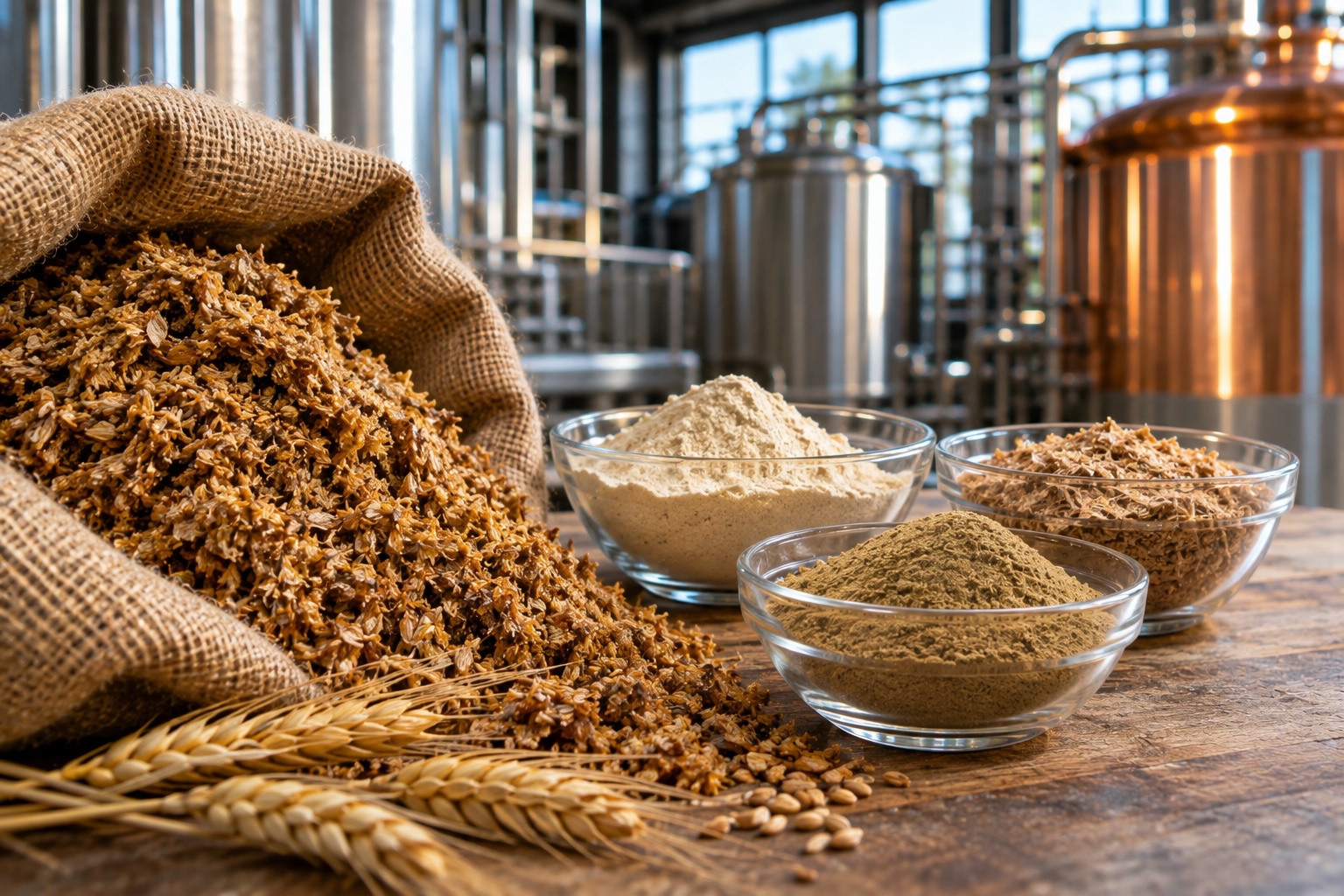
The brewing industry generates substantial quantities of secondary materials, among which brewer’s spent grain (BSG) represents the largest solid by-product of beer production. Produced during mashing and lautering, spent grain consists primarily of the insoluble components of malted cereals remaining after the extraction of fermentable sugars. Traditionally used as animal feed, this material contains proteins, dietary fibre, phenolic compounds and other constituents with potential applications in food ingredients, nutraceuticals and specialised industrial formulations. For breweries, recovering these components represents an opportunity to develop additional revenue streams while improving resource efficiency. However, industrial valorisation requires appropriate extraction technologies, reliable product specifications and a clear understanding of market demand.
Brewer’s Spent Grain as an Industrial Resource
The composition of brewer’s spent grain depends on the cereals used, malting conditions, brewing recipes and production processes. Barley malt generally represents the principal raw material, although wheat, oats and other cereals may contribute to its composition. Following wort separation, BSG retains proteins, cellulose, hemicellulose, lignin, residual lipids and phenolic compounds. Its high moisture content, frequently around 70–80%, represents a significant challenge for storage and transportation. Without appropriate stabilisation, spent grain can deteriorate rapidly through microbial activity, making drying, refrigeration or other preservation methods necessary for certain applications. These characteristics influence the location and economic feasibility of recovery facilities, particularly when processing operations are not integrated directly with breweries. Reliable raw material availability, consistent composition and efficient logistics are therefore essential considerations when developing an industrial valorisation project.
Protein Recovery and Functional Ingredients
Proteins represent one of the most interesting fractions of brewer’s spent grain, particularly in relation to demand for alternative protein sources and functional food ingredients. Their recovery is complicated by the lignocellulosic structure of the material, which can limit accessibility during extraction. Potential technologies include alkaline extraction, enzymatic treatments and mechanical separation, while ultrasound-assisted extraction may improve mass transfer and facilitate protein release under optimised conditions. However, commercial value depends on more than protein concentration or extraction yield. Solubility, digestibility, emulsifying properties, flavour and stability determine suitability for different food formulations. Manufacturers also require consistent analytical specifications, microbiological compliance and appropriate allergen management. Developing commercially relevant protein ingredients therefore requires extraction processes designed around the functional characteristics expected by industrial customers.
Dietary Fibre and Bioactive Compounds
Brewer’s spent grain contains substantial quantities of dietary fibre, particularly cellulose, hemicellulose and lignin. Arabinoxylans, important components of cereal cell walls, are attracting interest for potential applications in food formulations and functional ingredients. Depending on processing conditions, fibre fractions may be recovered or modified to achieve specific characteristics, including particle size, water-binding capacity and solubility. BSG also contains phenolic compounds, including ferulic acid and p-coumaric acid, which are frequently associated with the structural components of the grain matrix. Recovering these compounds may require enzymatic, chemical or physical treatments capable of releasing bound phenolics. Their potential applications include antioxidant ingredients and specialised formulations, although commercial development requires evidence of stability, safety and technological performance. The possibility of recovering both fibre and phenolic compounds creates opportunities for integrated processing strategies, provided that extraction costs and market requirements justify the additional complexity.
Ultrasound-Assisted Extraction and Process Optimisation
The complex structure of brewer’s spent grain makes extraction technology particularly important for efficient compound recovery. Ultrasound-assisted extraction represents a promising approach because acoustic cavitation can improve mass transfer and facilitate interactions between extraction media and plant tissues. Depending on operating conditions, ultrasound may support the recovery of proteins and phenolic compounds, potentially reducing processing times or solvent requirements compared with certain conventional methods. Its effectiveness depends on parameters including temperature, treatment duration, ultrasound intensity, solvent composition and solid-to-liquid ratio. These conditions must be optimised according to the target compounds, as treatments suitable for phenolic extraction may not preserve the functional characteristics required for protein ingredients. Industrial feasibility also depends on filtration, separation, concentration, energy consumption and equipment performance. The objective is to develop reproducible processes capable of delivering consistent ingredient quality at economically sustainable production costs.
Integrated Valorisation and Industrial Feasibility
The presence of several potentially valuable fractions makes brewer’s spent grain suitable for investigation within an integrated biorefinery approach. Sequential recovery processes may allow proteins, phenolic compounds and fibre-rich materials to be directed towards different industrial applications, potentially increasing the overall value generated from the original raw material. However, extraction sequences must be carefully designed because recovering one fraction can influence the quality and availability of others. Economic feasibility depends on material balances, extraction yields, purification requirements and the commercial value of each product. The high moisture content of BSG also makes transportation and stabilisation important cost factors, favouring processing facilities located close to breweries or integrated into existing industrial infrastructure. Before investing in production equipment, potential markets must be evaluated to establish whether the recovered ingredients can compete with established alternatives in terms of quality, functionality and price.
Buyer Requirements and Commercial Development
A central challenge in brewer’s spent grain valorisation is transforming technically recoverable compounds into ingredients that industrial customers are prepared to purchase. Food manufacturers may prioritise protein functionality, flavour and formulation compatibility, while fibre ingredient buyers may require specific particle sizes, solubility characteristics and consistent performance. Companies interested in phenolic extracts may demand standardised concentrations, defined analytical profiles and documented stability. Regulatory compliance is equally important, particularly for ingredients intended for food and nutraceutical applications. Depending on their composition, processing methods and intended uses, recovered ingredients may require specific regulatory assessments, including consideration of European Union novel food legislation. Allergen management is another relevant factor because BSG commonly originates from gluten-containing cereals. These requirements should guide research and development from the beginning, reducing the risk of producing extracts without a clearly identifiable commercial application.
Joint Ventures and New Opportunities for Breweries
For breweries, developing specialised ingredients from spent grain may require technological and commercial capabilities beyond traditional beer production. Joint ventures can provide a framework for combining complementary resources, allowing breweries to contribute raw materials, industrial infrastructure and operational expertise while specialised partners provide extraction technologies, ingredient development and access to potential customers. A structured development programme can begin with raw material characterisation and market assessment, followed by laboratory research, pilot-scale validation and industrial implementation. This approach allows investment decisions to reflect both technological performance and commercial feasibility, creating opportunities for breweries to participate in new ingredient businesses without independently developing every capability required for production and distribution.
Letoon’s Approach to Brewer’s Spent Grain Valorisation
At Letoon, we approach brewer’s spent grain valorisation by connecting scientific research, industrial extraction technologies and clearly identified market opportunities. Our interest focuses on evaluating the recovery of proteins, dietary fibre and bioactive compounds through processes capable of delivering consistent quality and economically sustainable production. Ultrasound-assisted extraction represents one of the technologies considered within this framework, alongside complementary separation and purification methods. We believe that successful projects require collaboration between breweries, technology specialists and ingredient manufacturers from the earliest stages of development. Through structured partnerships and joint ventures, brewer’s spent grain can become a resource for developing new industrial ingredients while contributing to more efficient and circular production models. The real opportunity lies not simply in recovering valuable compounds, but in transforming them into reliable products that meet specific customer requirements and support sustainable industrial businesses.