
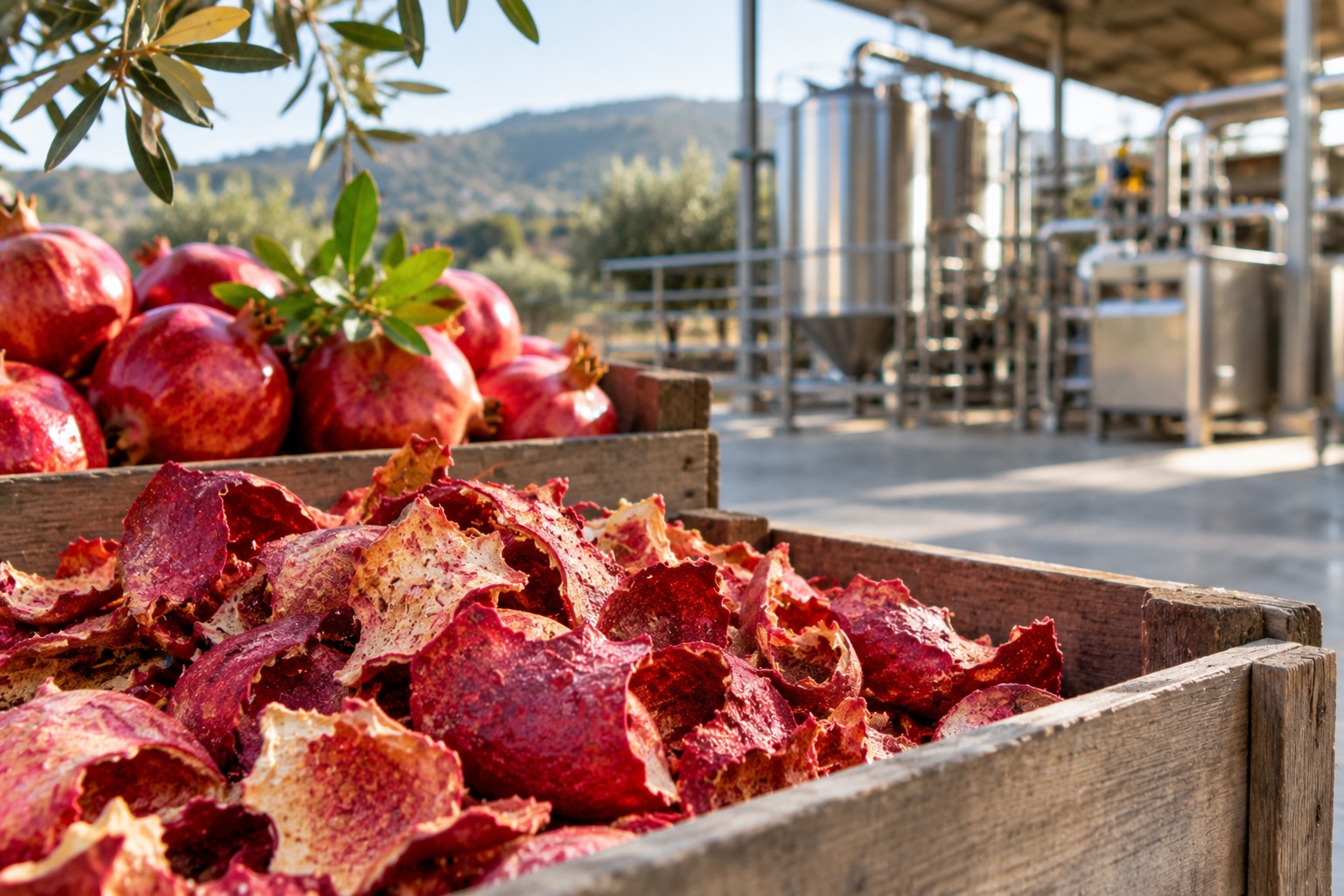
Pomegranate processing generates substantial quantities of secondary materials, particularly peels, membranes and seeds, which can represent a significant proportion of the original fruit weight. While juice production and fresh fruit processing remain the primary commercial activities, these materials contain compounds of considerable interest for the development of functional ingredients. Pomegranate peel, in particular, is recognised as a rich source of polyphenols, including punicalagins, ellagic acid and other phenolic constituents with potential applications in food, nutraceuticals, cosmetics and specialised industrial formulations. For pomegranate processors, the recovery of these compounds offers an opportunity to transform agricultural by-products into additional sources of commercial value. However, developing a viable ingredient business requires a structured approach that connects raw material availability, extraction technologies, product specifications and market demand.
Pomegranate Peel as an Industrial Raw Material
The composition of pomegranate processing by-products depends on fruit variety, geographical origin, cultivation conditions, maturity and processing methods. Peels generally contain substantial concentrations of phenolic compounds, alongside dietary fibre, polysaccharides and other constituents that may support different industrial applications. Their relatively high concentration of hydrolysable tannins makes them particularly interesting for the recovery of antioxidant compounds, although composition can vary significantly between production batches. From an industrial perspective, this variability must be considered from the earliest stages of development. The availability of raw materials is influenced by agricultural seasonality and the geographical concentration of processing facilities, while storage conditions can affect the stability and quality of the compounds targeted for extraction. Fresh pomegranate peels contain considerable moisture and may require stabilisation, drying or other preliminary treatments before further processing. These operations influence extraction performance, energy consumption and overall production costs. Consequently, the industrial potential of pomegranate peel depends not only on its chemical composition but also on the ability to establish a reliable and economically sustainable supply chain.
Polyphenols and Their Commercial Potential
Pomegranate peel contains a complex mixture of phenolic compounds, among which punicalagins are particularly significant. These compounds belong to the family of ellagitannins and contribute substantially to the antioxidant activity observed in pomegranate peel extracts. Ellagic acid, gallic acid and other phenolic constituents may also be present, creating opportunities for the development of ingredients with different analytical profiles and intended applications. However, the commercial value of an extract cannot be determined exclusively by its total polyphenol concentration or antioxidant activity measured under laboratory conditions. Industrial buyers frequently require standardisation based on specific compounds, defined purity levels, consistent analytical methods and documented stability. An extract standardised for punicalagins, for example, may address different formulation requirements from one characterised primarily by ellagic acid content. The relationship between these compounds, their chemical stability and their behaviour during processing must therefore be evaluated carefully. Establishing a reproducible phenolic profile is essential for transforming a variable agricultural by-product into an ingredient suitable for industrial supply.
Applications in Food, Nutraceuticals and Cosmetics
The potential applications of pomegranate peel extracts extend across several industrial sectors, each characterised by distinct technical and regulatory requirements. In food applications, polyphenol-rich extracts may be investigated as antioxidant ingredients or components of specialised formulations, provided that their safety, regulatory status and technological compatibility are established. Their use can be influenced by factors such as colour, bitterness, astringency, solubility and interactions with other ingredients. The nutraceutical sector represents another potential market, particularly for standardised extracts containing defined concentrations of punicalagins or ellagic acid. Scientific research has investigated various biological activities associated with pomegranate polyphenols, but experimental findings must be distinguished from clinically demonstrated benefits and authorised commercial claims. In the European Union, the regulatory status of a particular extract, its production process and intended use must be assessed before commercialisation. Cosmetic applications may include formulations in which antioxidant properties, ingredient stability and compatibility with different delivery systems are relevant. Across all these sectors, successful market entry depends on meeting specific buyer requirements rather than relying on the general reputation of pomegranate as a source of beneficial natural compounds.
Extraction Technologies and Industrial Process Development
The recovery of polyphenols from pomegranate peel requires extraction processes designed around the characteristics of the raw material and the specifications of the intended ingredient. Conventional extraction methods commonly employ water, ethanol or hydroalcoholic mixtures, with operating conditions selected according to the target compounds and desired extraction performance. Ultrasound-assisted extraction represents a technological option of particular interest because acoustic cavitation can improve mass transfer and facilitate the release of compounds from plant tissues. Under appropriately optimised conditions, this approach may reduce extraction times, improve recovery efficiency or lower solvent requirements compared with certain conventional processes. Nevertheless, the effectiveness of ultrasound-assisted extraction depends on several interacting parameters, including solvent composition, temperature, treatment duration, ultrasound intensity and solid-to-liquid ratio. Excessive processing conditions may also affect the stability of sensitive compounds, making optimisation essential. Industrial development must consider the entire production sequence, including raw material preparation, extraction, solid-liquid separation, concentration, purification and possible drying. The resulting ingredient must satisfy defined quality parameters while maintaining economically acceptable yields and operating costs. Laboratory extraction efficiency is therefore only one component of a broader industrial feasibility assessment.
Standardisation, Quality Control and Buyer Requirements
One of the most important challenges in pomegranate peel valorisation is achieving consistent ingredient quality despite the natural variability of agricultural raw materials. Industrial customers require products that can be incorporated into established manufacturing processes without significant fluctuations in composition or performance. This generally involves defining analytical specifications, identifying suitable marker compounds and implementing quality control procedures throughout production. Depending on the intended application, specifications may include total polyphenol content, punicalagin concentration, ellagic acid levels, residual solvents, microbiological parameters, contaminants and stability under defined storage conditions. The analytical methods used to measure these characteristics must also be appropriate and reproducible. For manufacturers operating in regulated sectors, traceability, documentation and compliance with relevant quality standards can be decisive factors in supplier qualification. These requirements should influence research and development from the beginning. Developing an extract before identifying its intended customer may result in a technically interesting product that requires substantial additional work to meet commercial expectations. A market-oriented development strategy instead begins by understanding which compounds, concentrations and quality characteristics buyers are prepared to incorporate into their formulations.
Beyond Polyphenols: Opportunities for Integrated Valorisation
Although polyphenols are among the most commercially interesting constituents of pomegranate peel, they are not the only materials that may support industrial applications. Pomegranate peel also contains fibre and polysaccharide fractions, including pectic substances, which may offer opportunities for further investigation. The feasibility of recovering these materials depends on their composition, functional properties, extraction requirements and potential markets. An integrated approach could examine the sequential recovery of different fractions, allowing processors to evaluate whether additional value can be generated from materials remaining after polyphenol extraction. However, multiple recovery stages introduce technical and economic complexity. Extraction sequences must be designed to preserve the quality of the intended products while controlling energy consumption, water requirements and processing costs. The commercial value of each fraction must also justify the additional investment required for its recovery and purification. Integrated valorisation should therefore be based on realistic material balances and market opportunities rather than the assumption that every component of a processing residue can become a profitable ingredient.
Industrial Feasibility and the Economics of Valorisation
Transforming pomegranate peel into a commercial ingredient requires careful evaluation of the relationship between raw material availability, production costs and achievable market value. Processing volumes, seasonal concentration, transportation distances and storage requirements influence the scale and location of potential extraction facilities. The moisture content of fresh peels can make long-distance transportation economically inefficient, while drying and stabilisation introduce additional operating costs. Extraction yields must be evaluated in relation to the actual concentration of commercially relevant compounds rather than the total mass of recovered material. Purification requirements, solvent recovery, energy consumption and quality control can significantly influence production economics. At the same time, the potential selling price depends on ingredient specifications, competitive alternatives, regulatory positioning and customer qualification requirements. These considerations make early commercial validation particularly important. Before committing substantial capital to an industrial facility, processors and technology partners should establish whether the proposed ingredient addresses an identifiable market requirement and whether its production costs are compatible with realistic commercial conditions.
Joint Ventures and New Ingredient Business Models
Pomegranate processors often possess the raw material availability and industrial infrastructure necessary to support valorisation projects, but may not have the specialised expertise required to develop, standardise and commercialise functional ingredients. Joint ventures can provide a framework for combining these complementary capabilities. Processing companies can contribute access to secondary materials, operational experience and local industrial resources, while specialised partners contribute extraction technologies, scientific expertise, formulation knowledge and commercial development. Such partnerships can support a progressive approach to investment, beginning with raw material characterisation and laboratory evaluation before advancing to pilot-scale validation, customer qualification and industrial implementation. The objective is to reduce technological and commercial uncertainty while creating a business model capable of generating sustainable value. In this context, buyer requirements should be considered a fundamental part of industrial feasibility, not an issue to be addressed after the extraction process has been developed.
Letoon’s Approach to Pomegranate Peel Valorisation
At Letoon, we approach pomegranate peel valorisation as an opportunity to connect agricultural processing resources with scientific research, industrial technologies and clearly defined commercial applications. Our interest extends beyond the recovery of polyphenols to the development of processes capable of producing standardised ingredients that meet the requirements of industrial customers. Ultrasound-assisted extraction represents one of the technologies considered within this framework, alongside the separation, purification and formulation processes necessary to obtain commercially relevant products. Particular attention is given to the relationship between raw material characteristics, extraction performance, product specifications and economic sustainability. We believe that successful valorisation projects should be developed through collaboration between processors, technology specialists and potential buyers, allowing technical research and commercial validation to progress together. By integrating these capabilities within structured industrial partnerships and joint ventures, pomegranate processing by-products can become the starting point for new ingredient businesses and contribute to a more efficient use of agricultural resources. The real opportunity lies not simply in demonstrating that valuable compounds can be extracted from pomegranate peel, but in establishing the conditions under which those compounds can become reliable, competitive and commercially viable industrial ingredients.