
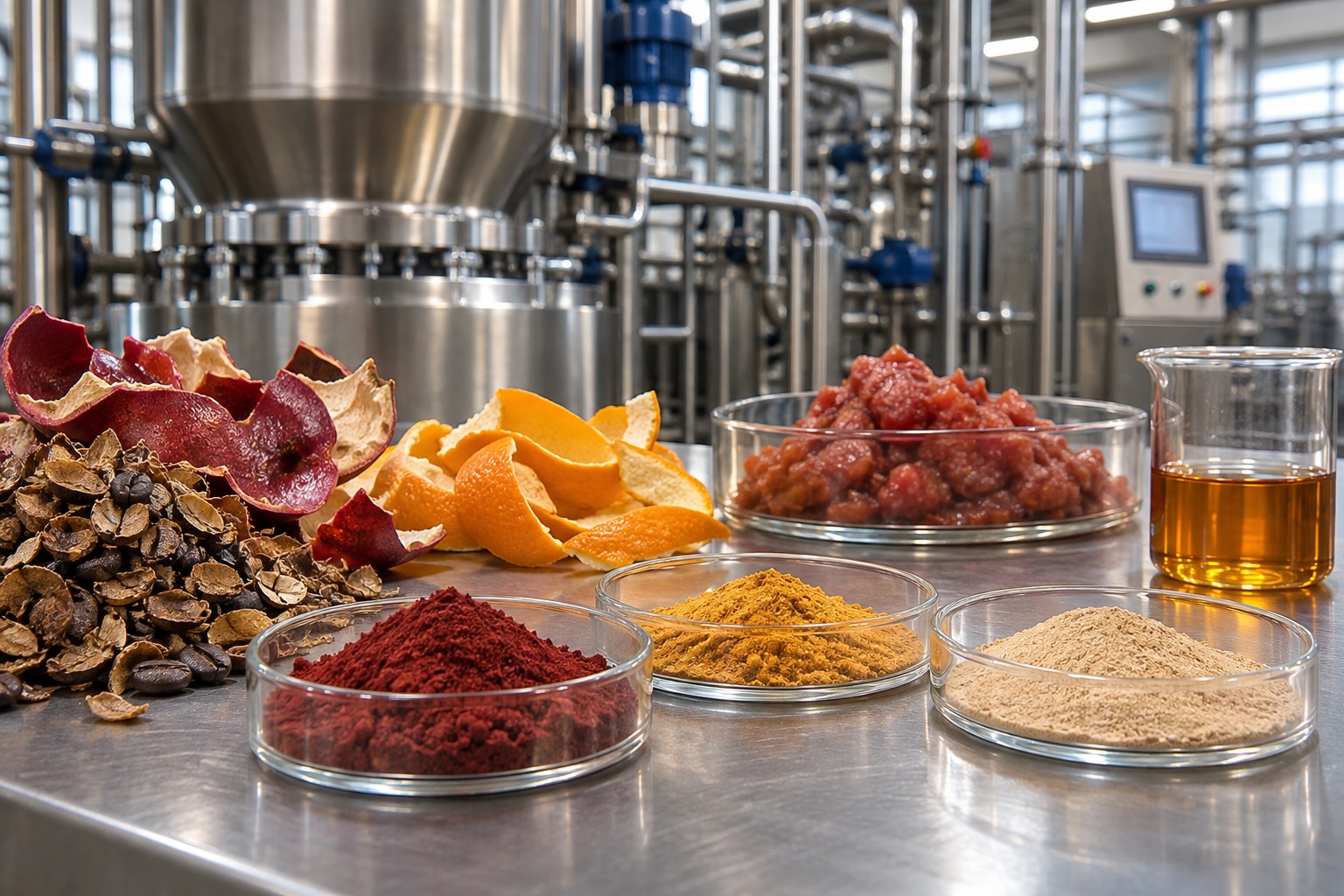
The global agro-food industry generates substantial volumes of secondary materials during the processing of fruits, vegetables, cereals, coffee and other agricultural commodities. Peels, seeds, pomace, husks, fibres and processing residues are often treated as waste or directed towards low-value applications, despite containing compounds with potentially significant commercial value. Agro-food by-product valorisation offers an opportunity to reconsider these materials as industrial resources. Through appropriate processing technologies and carefully designed business models, agricultural and food-processing companies can explore new revenue streams while improving resource efficiency and reducing their environmental impact.
However, transforming a by-product into a commercially viable ingredient requires more than identifying its chemical composition. Industrial feasibility depends on the relationship between raw material availability, extraction technologies, production costs, regulatory requirements and market demand. A material with promising laboratory results does not automatically represent an attractive industrial opportunity. Consistent supply, predictable quality and economically sustainable processing conditions are essential prerequisites.
Many agro-food by-products retain valuable components after primary processing. These may include polyphenols, carotenoids, dietary fibres, pectins, proteins, oils and other functional compounds suitable for applications across several industries. Tomato processing residues, for example, may provide opportunities for recovering carotenoids, fibres and other functional fractions. Citrus peels contain pectins, essential oils and flavonoids, while pomegranate peels and seeds offer potential sources of polyphenols and other bioactive compounds. Coffee processing generates husks, pulp and silverskin, each presenting different possibilities for ingredient development. Similarly, olive processing residues, avocado by-products and brewery spent grain may contain fractions of interest for food, nutraceutical, cosmetic and other industrial applications.
The commercial potential of these materials varies considerably. Their composition, moisture content, seasonal availability, storage requirements and geographical concentration influence the technologies and business models that can be adopted. Processing facilities generating substantial and relatively consistent volumes of secondary materials may offer advantages in collection, handling and transportation. Nevertheless, the economic value of a by-product cannot be assessed solely through its potential selling price. Pre-treatment, drying, storage, extraction, purification, quality assurance, packaging and logistics all contribute to the final production cost.
Technological development plays a central role in converting agro-food by-products into higher-value ingredients. Conventional extraction processes may involve significant consumption of solvents, energy and water. Alternative technologies, including ultrasound-assisted extraction, offer opportunities to improve mass transfer, reduce processing times and optimise the recovery of selected compounds under suitable operating conditions. Ultrasound-assisted extraction can be particularly relevant when processing plant materials containing compounds that require controlled extraction conditions. Depending on the feedstock and target ingredient, the technology may contribute to improved extraction efficiency and process optimisation.
Nevertheless, the selection of an extraction technology must reflect the characteristics of the raw material and the specifications of the intended product. Laboratory performance represents only the initial stage. Industrial development requires evaluation of process scalability, equipment configuration, energy consumption, extraction yields, downstream purification and operating costs. The objective is not simply to maximise the recovery of a compound, but to establish a reproducible and economically viable production process.
One of the most important considerations in agro-food by-product valorisation is identifying the potential customer before committing substantial resources to industrial development. A recovered ingredient may have several theoretical applications, but each market has different technical, regulatory and commercial requirements. Food manufacturers may prioritise functional performance, stability, sensory characteristics and consistency between production batches. Nutraceutical companies may require standardised concentrations of selected compounds, analytical documentation and evidence supporting the intended application. Cosmetic manufacturers may evaluate purity, formulation compatibility, traceability and compliance with relevant regulations.
These requirements directly influence the development programme, including extraction methods, purification processes, quality controls and production specifications. Understanding buyer expectations at an early stage helps reduce the risk of developing technically interesting ingredients without a realistic route to market. Commercial feasibility should therefore be considered alongside scientific and technological feasibility, rather than treated as a separate activity once production has been established.
Industrial projects must also consider whether multiple valuable fractions can be recovered from the same feedstock. An integrated approach may improve resource utilisation by combining the extraction of higher-value compounds with the subsequent valorisation of remaining materials. The most promising opportunities are those where technological performance, market demand and production economics can be aligned within a sustainable industrial model. Seasonal variations and changes in raw material composition must also be considered, particularly when developing processes intended to operate continuously throughout the year.
Agro-food by-product valorisation frequently requires capabilities that are not available within a single organisation. Agricultural producers and food processors may control access to substantial quantities of raw materials but lack the technological infrastructure, specialised expertise or commercial relationships needed to develop new ingredient businesses. Conversely, technology providers and ingredient specialists may possess advanced extraction capabilities without direct access to suitable feedstock or established industrial facilities. Strategic partnerships can connect these complementary resources and create the conditions for developing new industrial activities.
Joint ventures offer one possible structure for integrating raw material supply, technological development, industrial investment and commercial expertise. Their feasibility depends on clearly defined responsibilities, realistic investment requirements and a shared understanding of the intended market. In international projects, additional considerations include local infrastructure, logistics, regulatory frameworks, product quality assurance and access to target markets. A successful industrial partnership must therefore be designed around the entire value chain, from the availability of agricultural materials to the delivery of ingredients that meet customer specifications.
At Letoon, agro-food by-product valorisation is approached as an integrated industrial development opportunity. The objective is to connect scientific expertise, extraction technologies, industrial resources and commercial requirements to evaluate the feasibility of transforming secondary agricultural materials into marketable ingredients. Our approach considers the characteristics of the available feedstock, the potential applications of recoverable compounds, the technologies required for their extraction and the economic conditions necessary for industrial production.
Particular attention is given to identifying commercially relevant applications and understanding the specifications required by potential buyers. Through collaboration with industrial partners and the development of potential joint ventures, Letoon aims to create opportunities that combine technological innovation with practical industrial implementation. The transition towards a more circular agro-food economy will depend not only on the ability to recover valuable compounds from secondary materials, but also on the development of business models capable of supporting their production and commercialisation.
Agro-food by-products represent a potentially valuable resource. Transforming that potential into industrial value requires scientific knowledge, technological capability, commercial understanding and long-term strategic cooperation.