
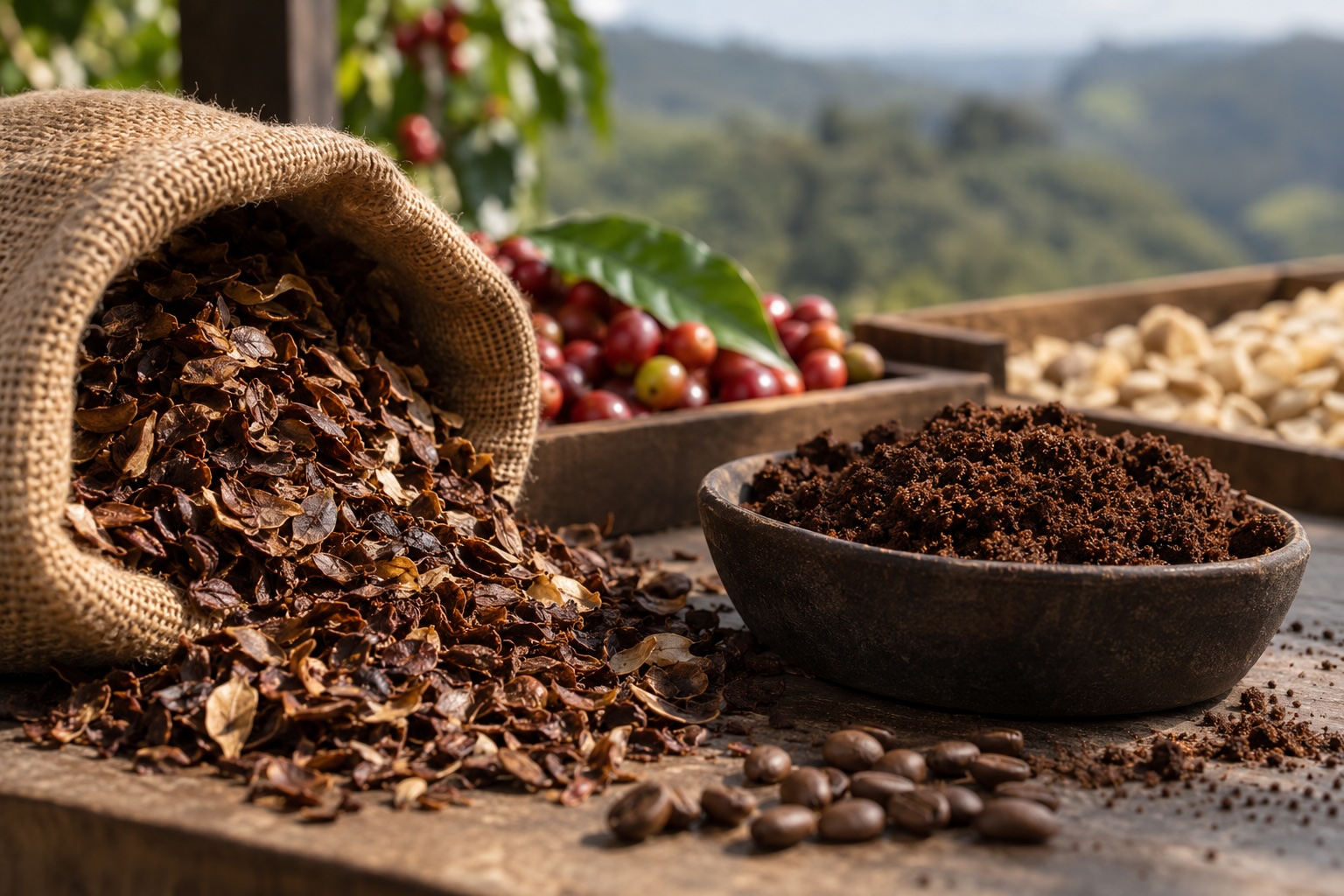
Coffee is one of the world’s most widely produced and traded agricultural commodities, but the coffee that reaches the consumer represents only part of a much larger material flow. During harvesting, processing, drying, roasting and industrial transformation, different residual fractions are generated, including pulp, husk, parchment, silverskin and spent coffee grounds. These materials are commonly grouped under the broad definition of coffee waste, but from an industrial perspective this definition can be misleading. Many of these by-products still contain compounds and fractions that may have potential value for the food, nutraceutical, cosmetic and other industries. The relevant question is therefore not simply how these materials can be disposed of or reused, but whether some of them can become secondary raw materials from which higher-value ingredients can be recovered.
A complex raw material rather than a single waste stream
Coffee by-products should not be considered as a homogeneous category. Their composition varies significantly according to coffee species, geographical origin, cultivation conditions and, above all, the processing stage from which the material originates. Coffee pulp has different characteristics from husk or parchment, while silverskin generated during roasting represents a completely different matrix from spent coffee grounds after brewing or industrial extraction. Within these materials it is possible to find polyphenols, chlorogenic acids, caffeine, lipids, proteins, fibres and other potentially interesting fractions, but their concentration and accessibility can vary considerably. For this reason, characterisation of the individual matrix is essential before considering any extraction process. The presence of a valuable molecule alone does not make a by-product commercially valuable: the compound must be present in a meaningful concentration, recoverable with an efficient process and capable of producing an ingredient that meets the technical, regulatory and economic requirements of a real market.
Extraction can change the economics of a by-product
Traditional waste management generally looks at residual biomass in terms of handling, transportation, treatment and disposal costs. Extraction introduces a different perspective by asking whether valuable fractions can be selectively recovered before the remaining material is directed towards lower-value applications. This can create a cascade approach in which a coffee by-product is first evaluated as a potential source of bioactive or functional compounds, while the residual solid fraction may subsequently be considered for applications involving fibre, energy recovery, composting or other uses. The objective is not to assume that every kilogram of coffee residue can or should be transformed into a premium ingredient. In many situations this would not be technically realistic or economically justified. The opportunity lies instead in identifying specific combinations of matrix, target compound, extraction technology and end market where the recovery process can generate sufficient value to justify industrial development.
Bioactive compounds and potential applications
Among the compounds naturally associated with coffee, chlorogenic acids are particularly interesting because of their antioxidant properties and their potential applications in nutraceutical, functional food and cosmetic formulations. Caffeine represents another important target, supported by established demand across several industries, while different coffee-derived matrices may also contain other phenolic compounds, oils and functional fractions that deserve further investigation. Coffee silverskin, for example, has attracted growing attention because it is generated during roasting and still contains potentially valuable compounds, while spent coffee grounds represent a large and widely distributed material stream with a very different chemical and physical profile. Coffee pulp and husk generated closer to the agricultural production stage present yet another set of characteristics and opportunities. This diversity explains why the generic concept of “coffee waste extraction” is of limited practical value: every matrix needs to be studied independently in relation to its composition, availability and most promising target compounds.
The role of extraction technology
The feasibility of recovering valuable compounds depends heavily on the extraction process used. Conventional techniques can require significant quantities of solvents, relatively long processing times, elevated temperatures or substantial energy consumption, all factors that may influence both the economics of the process and the characteristics of the compounds being recovered. Ultrasound-assisted extraction represents one of the technological approaches that can improve mass transfer between the plant matrix and the extraction medium. Through the physical effects generated by ultrasound, cellular structures can be disrupted more effectively, facilitating the release of target compounds and potentially allowing extraction conditions, processing times or solvent consumption to be optimised. Technology alone, however, cannot create an industrial opportunity. Solvent selection, temperature, ultrasound intensity, processing time, solid-to-liquid ratio, filtration, concentration and downstream purification must all be developed around the characteristics of the specific raw material and the requirements of the intended final ingredient. The process therefore needs to begin with the matrix and the target application rather than with the extraction equipment itself.
Creating value closer to the source
Coffee-producing countries generate substantial quantities of by-products at different stages of the supply chain, and many of these materials are concentrated around processing facilities. This geographical concentration can create favourable conditions for local valorisation projects because transporting wet, unstable or relatively low-value biomass over long distances can rapidly undermine both the economics and the environmental rationale of the process. Stabilising the material or recovering valuable fractions closer to the point where the by-product is generated may reduce logistical inefficiencies and, at the same time, allow a greater portion of the value chain to remain within producing regions. This opens a broader industrial perspective in which coffee-producing countries are not considered exclusively as suppliers of agricultural commodities but potentially also as producers of higher-value ingredients derived from materials that are currently underutilised. Such opportunities nevertheless need to be evaluated individually, considering biomass availability and consistency, seasonality, logistics, local infrastructure, energy and water requirements, processing capabilities and regulatory conditions.
From laboratory extraction to an industrial opportunity
Demonstrating that a valuable compound can be extracted from a coffee by-product is only the beginning. An industrial project ultimately needs to connect three fundamental elements: a reliable and sufficiently concentrated source of raw material, a technically and economically scalable extraction process, and a market capable of absorbing the resulting ingredient at a sustainable value. Preliminary characterisation and pilot-scale work are therefore critical. The composition of the material needs to be analysed, target compounds identified, extraction yields measured and different process conditions compared. At the same time, the resulting extracts must be evaluated against existing ingredients already available to the nutraceutical, cosmetic, food or other relevant industries. Only by connecting technical feasibility with market requirements is it possible to determine whether a particular coffee by-product represents a genuine industrial opportunity.
For Letoon, the interest in coffee processing by-products starts precisely from this perspective. The objective is not to assume that every residual material has an intrinsic commercial value, but to identify where valuable compounds are present, determine whether they can be recovered efficiently and evaluate whether the resulting ingredients can support a technically and commercially sustainable value chain. Coffee by-products are therefore not automatically resources simply because they contain potentially useful molecules. Their transformation into higher-value ingredients requires knowledge of the matrix, appropriate extraction technology, process optimisation and a clear understanding of the target market. When these elements come together, however, a material that currently represents the end of one production process can potentially become the starting point of another.