
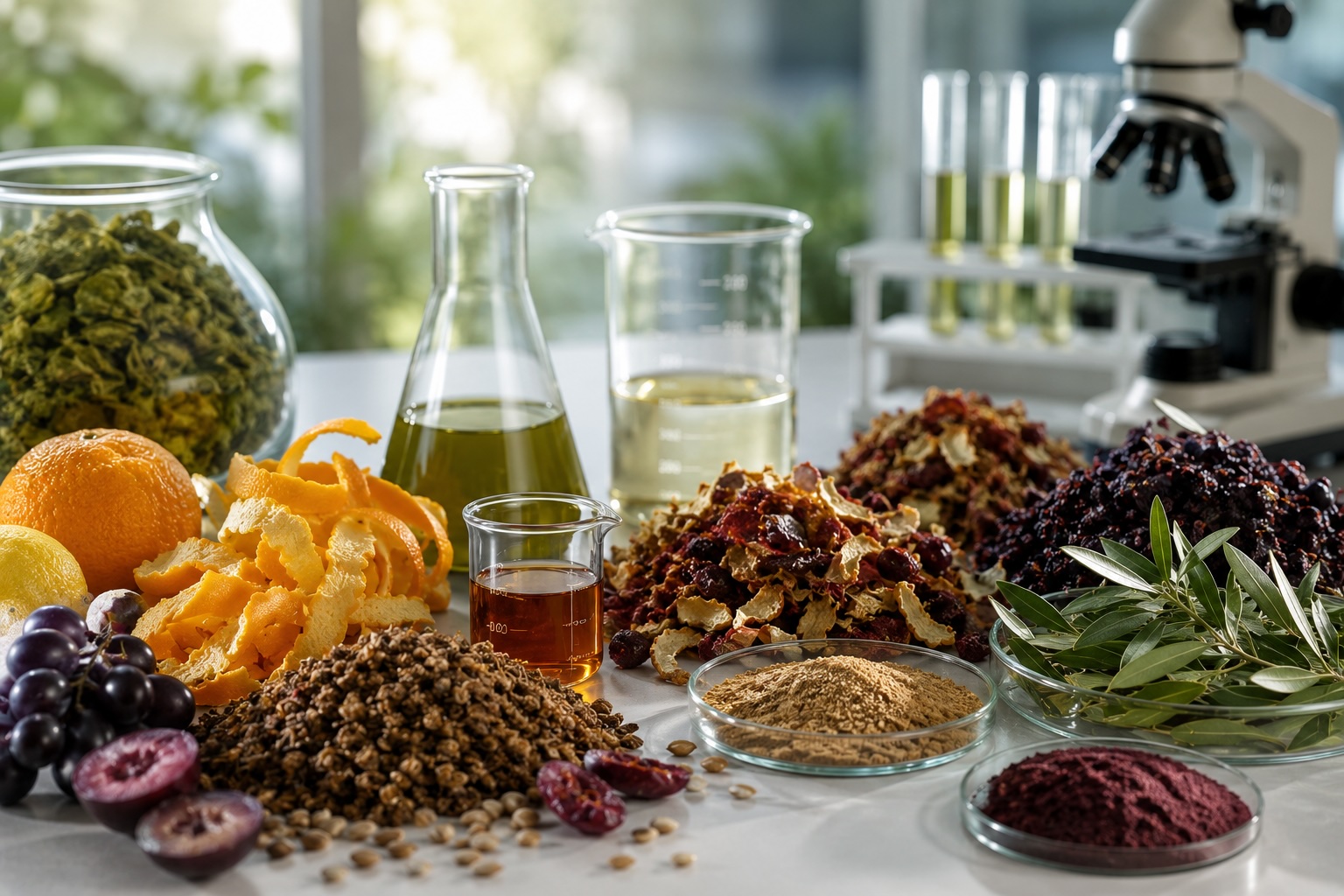
For many decades, food by-products were considered an inevitable consequence of industrial food production. Fruit peels, seeds, pomace, spent grains, vegetable residues and numerous other materials generated during processing were generally viewed as secondary outputs with limited economic value. Their management was primarily associated with logistics, disposal costs or, in the best cases, low-value applications such as animal feed, composting or energy production.
Today, this perspective is undergoing a profound transformation. What was once classified simply as production waste is increasingly being recognized as a valuable source of natural compounds with applications across multiple high-value industries. Advances in analytical chemistry, biotechnology and extraction technologies have demonstrated that many of these materials retain significant concentrations of bioactive molecules even after the primary production process has been completed.
This shift is not driven solely by sustainability goals or regulatory pressure. It reflects a broader evolution in industrial thinking, where every stage of the production chain is evaluated not only for its efficiency, but also for its potential to generate additional value. Companies are beginning to recognize that the materials leaving their facilities as disposal costs may actually represent the starting point for entirely new research projects, innovative ingredients and additional revenue streams.
From Secondary Output to Valuable Raw Material
Every industrial food process is designed to obtain a primary product. Wine producers focus on wine, olive mills produce olive oil, juice manufacturers extract fruit juice, breweries produce beer, and tomato processors manufacture sauces, concentrates or purees. During each of these processes, however, large quantities of secondary materials are generated as a natural consequence of separating different parts of the original raw material.
Historically, these by-products were rarely investigated beyond their immediate disposal or low-value reuse. The assumption was simple: once the desired product had been obtained, the remaining material possessed little additional commercial potential.
Scientific research has challenged this assumption. Numerous studies have demonstrated that many food by-products still contain significant quantities of valuable compounds that remain largely intact after processing. Polyphenols, flavonoids, carotenoids, dietary fibres, proteins, pectins, organic acids, essential oils and numerous other bioactive molecules often remain concentrated in skins, seeds, leaves, pulp and other plant fractions that are routinely discarded.
The realization that these compounds can be recovered and further developed has fundamentally changed how researchers and industrial companies evaluate food processing residues. Rather than considering them simply as waste to be managed, they are increasingly viewed as secondary raw materials capable of supporting entirely new industrial applications.
The Scientific Value Hidden Inside Food By-Products
The value of a food by-product does not lie in the material itself, but in its chemical composition. Modern analytical techniques allow researchers to investigate plant matrices with remarkable precision, identifying hundreds of naturally occurring molecules that contribute to antioxidant activity, pigmentation, preservation, nutritional properties or biological functionality.
Many compounds that attract considerable commercial interest today originate naturally within plants as protective mechanisms against environmental stress, pathogens or oxidation. During food processing, these molecules are often not destroyed but simply remain concentrated within fractions that are not included in the final commercial product.
Grape pomace, for example, may contain significant concentrations of polyphenols. Citrus peels are naturally rich in flavonoids, essential oils and pectins. Tomato skins contain carotenoids such as lycopene, while olive leaves and olive pomace continue to represent important sources of phenolic compounds. Brewery spent grains retain proteins, fibres and other components that continue to attract scientific interest for potential industrial applications.
Each production chain therefore represents a unique biological reservoir whose composition depends on numerous variables, including plant variety, geographical origin, cultivation methods, harvesting conditions, seasonal variations and industrial processing parameters.
Understanding this complexity requires scientific investigation rather than assumptions. Every by-product represents a distinct matrix that must be evaluated individually before its true potential can be determined.
Why Scientific Evaluation Comes Before Industrial Development
One of the most common misconceptions surrounding food by-product recovery is the belief that every production residue automatically represents a commercial opportunity. In reality, successful valorisation begins with scientific validation.
The same type of by-product may exhibit completely different chemical characteristics depending on its origin and processing history. Two batches of grape pomace produced by different wineries may contain substantially different concentrations of polyphenols. Citrus peels from different cultivars may vary considerably in flavonoid content. Even environmental factors such as rainfall, soil composition or harvest timing may influence the concentration of bioactive compounds.
For this reason, industrial recovery projects typically begin with laboratory characterization. Analytical studies determine which compounds are present, their concentration, their stability and the feasibility of recovering them through scalable extraction processes.
Only after this scientific foundation has been established does it become possible to evaluate technical feasibility, economic sustainability and potential commercial applications.
This methodology significantly reduces development risks. Instead of investing directly in industrial-scale production based on theoretical assumptions, companies obtain objective scientific data capable of guiding future investment decisions with far greater confidence.
Technology Is Expanding What Can Be Recovered
The growing interest in food by-products would not be possible without significant advances in extraction technologies. Traditional extraction methods have served industry for many years, yet they often involve long processing times, elevated temperatures or extensive solvent consumption that may reduce efficiency or affect sensitive compounds.
Modern technologies are helping overcome many of these limitations. Among the most promising approaches, ultrasound-assisted extraction has attracted considerable attention due to its ability to enhance mass transfer by generating microscopic cavitation phenomena within liquid media. These physical effects facilitate the release of intracellular compounds while allowing extraction under relatively mild operating conditions.
Depending on the characteristics of the target molecules, water-based extraction systems may also provide an effective alternative to conventional solvent-based processes, supporting cleaner production strategies and reducing environmental impact.
The objective is not simply to maximize extraction yield. Industrial development requires balancing extraction efficiency, compound stability, process scalability, operating costs, environmental performance and final product quality. Scientific optimization therefore focuses on identifying the extraction conditions that best preserve the functional properties of valuable compounds while remaining economically viable for future industrial production.
Beyond Sustainability: Building New Business Opportunities
The conversation surrounding food by-products is often dominated by environmental considerations. While sustainability undoubtedly plays an important role, reducing the topic to waste reduction alone overlooks its broader industrial significance.
For many companies, disposal represents a recurring operational expense that contributes little to long-term competitiveness. If part of these same production streams can instead become the basis for new ingredients, collaborative research projects or future commercial products, the economic implications become considerably more interesting.
This does not imply that every by-product will generate immediate revenue. Rather, it highlights the opportunity to investigate resources that have historically received limited scientific attention despite containing potentially valuable compounds.
The transition from disposal cost to strategic resource requires expertise in analytical chemistry, extraction process development, pilot-scale validation and industrial feasibility studies. It is this combination of scientific research and technological development that transforms a biological residue into a commercially relevant opportunity.
From Research to Industrial Application
Recovering a bioactive compound represents only the beginning of the development process. Before an ingredient can be considered for industrial use, numerous technical steps must be completed to ensure reliability, reproducibility and scalability.
Researchers must optimize extraction parameters, evaluate process repeatability, characterize the resulting extracts, assess stability, generate technical documentation and demonstrate that the process can be transferred from laboratory conditions to pilot or industrial production.
Each stage contributes to reducing technical uncertainty while providing future industrial partners with the information required to evaluate commercial feasibility.
This systematic approach distinguishes scientific valorisation from simple extraction activities. The objective is not merely to obtain an extract but to create the technical and scientific foundation necessary for future industrial development.
A New Industrial Mindset
Perhaps the most significant transformation is cultural rather than technological. Food manufacturers are gradually moving away from a linear production model in which value ends once the primary product has been obtained. Instead, companies are beginning to view every biological fraction generated during processing as a potential source of innovation deserving scientific investigation.
This mindset encourages collaboration between food manufacturers, research organisations, technology providers and industrial partners capable of transforming existing production streams into new opportunities for innovation.
As scientific knowledge continues to evolve and extraction technologies become increasingly sophisticated, food by-products are likely to assume an even more strategic role within modern industry. Their importance extends well beyond sustainability. They represent an opportunity to rethink resource management, stimulate research, develop new ingredients and unlock value that has remained hidden within existing production systems for decades.
For companies prepared to explore this potential, food by-products are no longer simply residues generated during manufacturing. They are strategic resources capable of supporting scientific innovation, industrial development and entirely new pathways for long-term growth